Nature Communications, 2022
Machine learning assisted interferometric structured illumination microscopy for dynamic biological imaging
Abstract
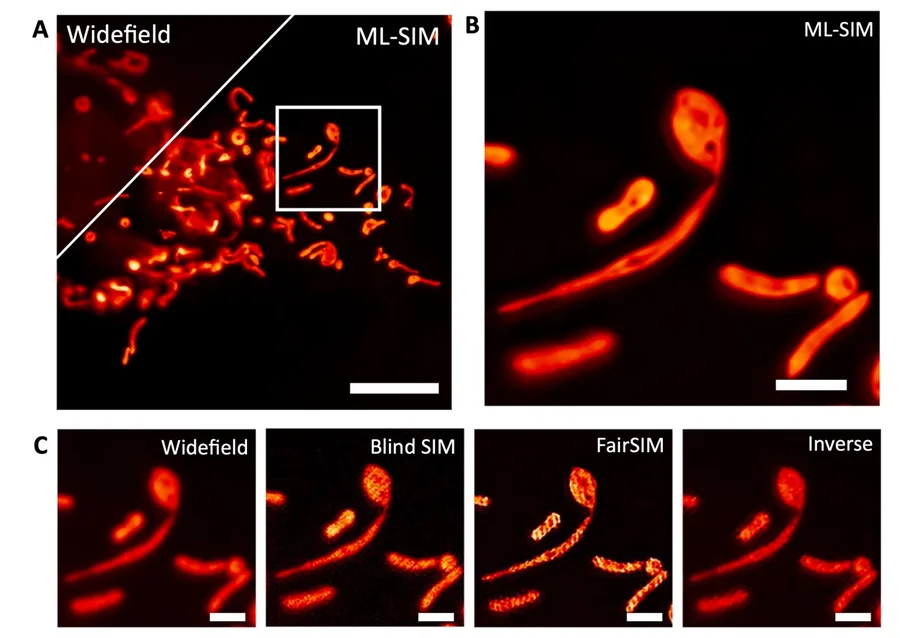
Structured Illumination Microscopy, SIM, is one of the most powerful optical imaging methods available to visualize biological environments at subcellular resolution. Its limitations stem from a difficulty of imaging in multiple color channels at once, which reduces imaging speed. Furthermore, there is substantial experimental complexity in setting up SIM systems, preventing a widespread adoption. Here, we present Machine-learning Assisted, Interferometric Structured Illumination Microscopy, MAI-SIM, as an easy-to-implement method for live cell super-resolution imaging at high speed and in multiple colors. The instrument is based on an interferometer design in which illumination patterns are generated, rotated, and stepped in phase through movement of a single galvanometric mirror element. The design is robust, flexible, and works for all wavelengths. We complement the unique properties of the microscope with an open source machine-learning toolbox that permits real-time reconstructions to be performed, providing instant visualization of super-resolved images from live biological samples.
Cite
@article{ward2022mai,
  title={MAI-SIM: interferometric multicolor structured illumination microscopy for everybody},
  author={Ward, Edward N and Hecker, Lisa and Christensen, Charles N and Lamb, Jacob R and Lu, Meng and Mascheroni, Luca and Chung, Chyi Wei and Wang, Anna and Rowlands, Christopher J and Schierle, Gabriele S Kaminski and others},
  journal={arXiv preprint arXiv:2206.00532},
  year={2022}
}